

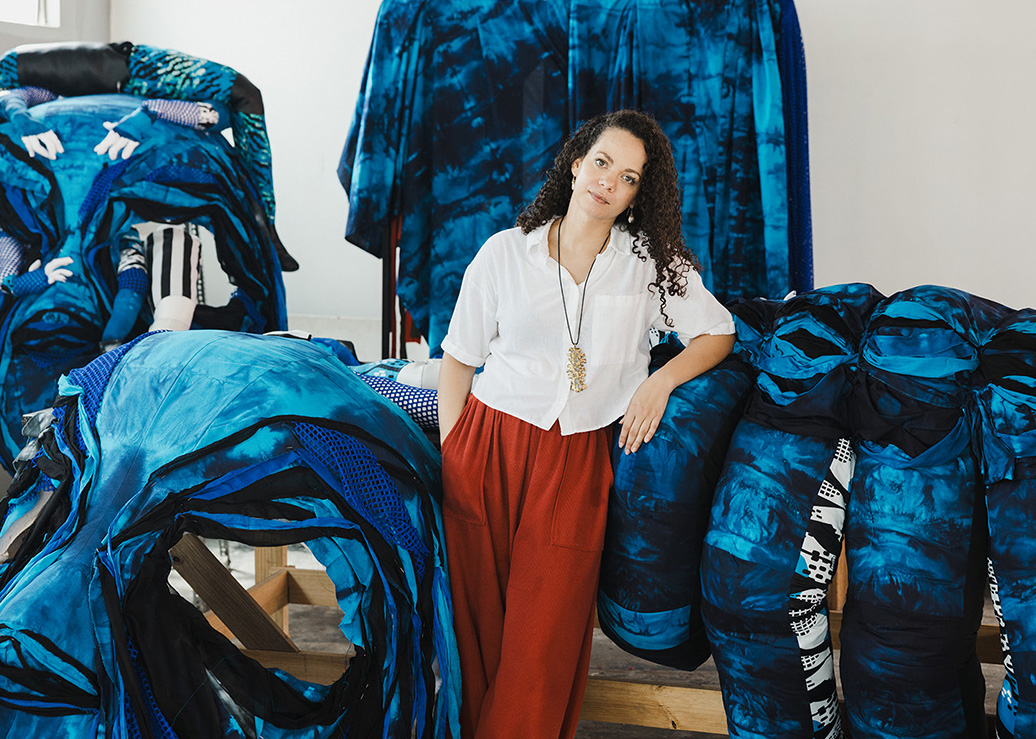
November 7th, 2025 (Photo by Jolene Cody)
Still strikingly solitary as a contemplation on time and memory, Shannon Alonzo’s continued review of notes on belonging from disparate manifestations of an ancestral hive mind grows warmer.
It is intimacy inviting a wider audience even as it takes on greater scale, and is more immersive in thought, texture and proportion.
Themes of labour, celebration, grief, restraint and respectability permeate the work in deliberate and unexpected ways, familiar, yet confrontational when articulated in a manner which, at once, communicates a quiet communion, reverence really, with and for the subject matter. We.
In the years since we first spoke in 2019, with her clothespin-festooned Washerwoman headlessly looming just over her right shoulder, Shannon Alonzo’s dialogue with the past has plumbed worlds both internally and inhabited by ideas of selves that resonate with the multidisciplinary artist.
Alonzo’s November 2024 to February 2025 stint at Prospect 6 The Future Is Present, The Harbinger Is Home (New Orleans) led straight into Sediments (Y Gallery, 2025) and is just the third solo showing she’s had at home, following Of smoke and Sunshine (Big Black Box, 2015) and Imprint (Loftt Gallery, 2019).
The years between Imprint and Sediment have put her mixed-media musings in front several new audiences.
At home Alonso’s mural on Y’s main wall, and the work sat around it, continued the ripple of archival memory in its original context.
What’s usually going through your mind when you’re working?
Shannon Alonzo: It’s difficult to say whether there is one specific train of thought that I return to, I think it varies based on the type of work and my mood at the time.
When I’m performing I usually get lost in the music I’m listening to and try to pay attention to the movement of my body, the rhythm created through my hands and the marks on the wall.
It’s sometimes difficult to completely tune out because I’m aware of people watching me on the periphery, which can be somewhat unnerving, but I try to be as fully present with the work as I can and create a sort of meditation out of the movement.
I think this is the only way I can really lean into the spontaneity of it all. I don’t think performing comes naturally to me, so instead I think about it as a dialogue between myself and the wall.
“I want to know how the lives of all those who have walked before us play a part in who we are today. How we relate to one another, why many of us feel inclined to the modes of self expression that we do, why we worship or seek God.”
Which is something I meant to ask; immediately after you reworked the mural, I could feel you sort of retreat into your thoughts of the experience. Is that (performing) something you’ve challenged yourself to become comfortable with?
Shannon Alonzo: Well, in the first instance, there is a lot of adrenaline involved in performing and it is also quite physically taxing, so the retreat is necessary from both a physical and emotional perspective.
It has certainly been a challenge, as someone who is naturally more of an introvert, putting myself ‘centre stage’ so to speak, in relation to my work.
This is particularly true of my most recent performance work ‘We’ve Darned the Same Cloth’, which was not centred around a wall drawing, but rather thinking about the process and nature of labour stereotypically associated with women.
It forced me to think more about the movements and posture of my body, where I was in relation to the audience and how I could manipulate various materials to evoke a fruitful encounter with the subject matter.
During the performance, which lasted a little over an hour, I was totally absorbed in this endeavour, but as soon as I walked away and the adrenaline died down I began to shake uncontrollably.
In large part because of the temperature in Vienna and the cold water I was using, but also, I think, because the version of myself that I summoned to be able to perform, is one that is not always readily accessible to me in everyday life.
Is there a larger vision connected to your body of work?
Shannon Alonzo: I think for a long time now the overarching story has been about belonging and attachment to place. Growing up my time was split between England and Trinidad and as I got older I was struck by how intertwined my spirit felt with the latter in contrast to the former.
I wondered if it was about family, culture and socialisation or whether there was something intangible, perhaps on a spiritual level, which rooted me in this space. I’m fascinated by those bonds, not just in relation to myself, but to everyone who may share a similar feeling.
I once referred to this as ‘subterranean sentiments of belonging’; the parts of us that live deep below the surface, perhaps in subconscious dialogue with the lands we inhabit.
When did the idea of connection, of memory, first become so prominent in your mind and did it transmute into the work merely as a consequence?
Shannon Alonzo: Great question. There are many reasons why the interplay of connection and memory have become so central to my work, perhaps too numerous to unpack here!
I would say, as I’m currently reading ‘Sapiens’ by Yuval Noah Harari, that I’ve been reminded of my long standing fascination with anthropology, history and spirituality (amongst other things). I want to know how the lives of all those who have walked before us play a part in who we are today. How we relate to one another, why many of us feel inclined to the modes of self expression that we do, why we worship or seek God.
There are so many unknowns and when I think of the history of our civilisation and all that it took for me to exist in this moment to be able to engage in this dialogue with you, it feels mind blowing.
When I see the cave paintings of hand prints made over 40,000 years ago, I wonder if they felt the same impetus, same emotions, same excitement as a small child today, stamping their hand prints in paint for the first time. That’s a possible connection that is almost unfathomable.
It’s one that makes me feel both insignificant and connected to something greater, all at once.
Can you speak about the Y show, where it found you, what the body of work meant, how’d you feel about its reception? and how does it fit into your oveure?
Shannon Alonzo: I began to develop ‘Sediments’ at a time when I was wrapping up a series of installation projects that had pushed me considerably; creatively, mentally and physically. I was looking at the remnants of these projects, the drawings and experiments I had done along the way, and seeing what threads tied them together.
I reflected on Carnival as a vessel of belonging; a means of remembrance and restoration that we return to through our yearly rituals.
I was thinking about the remnants of ourselves that we leave on the Carnival road long after the masquerade has died down and wondering what happens to this energy in the quiet spaces between festivals. I was thinking also about the female body and how it finds liberation through movement and creative expression.
All of this came together in the series of drawings and soft sculptures that were shown at Y Gallery.
It felt to me almost like the closing of a chapter. Not to say that I won’t continue to return to many of these things in my works to come, but I do feel like it is time for a shift into a new space or mode of working. What that might look like I’m not entirely sure just yet, but it is exciting nonetheless.
Can you speak to the significance of your visual language?
Shannon Alonzo: There are several motifs that have become embedded within my work, some conscious decisions and others the natural result of process and development.
One of the recurring images is of the striped leg, which I have used both in my 2D and 3D work over the past few years.
It originates from Melton Prior’s illustration of Carnival on Frederick Street, Port of Spain in 1888, where one of the central figures dances forward in these cabaret style tights.
My usage of it has come to mean several things; multiple limbs moving together, the past approaching the future via the present, the power of adornment.
Limbs, particularly when disconnected visually from the body, continue to be something that I’m fascinated with in relation to collective action. I’ve also used the symbol of interlocked arms, originating from an account of the Canboulay riots, to think through the power of multiple bodies, moving in unison as one body.
The mangrove is another element which repeats in many of my compositions. It began with my installation for the Liverpool Biennial, in which I used the mangrove as a symbol of refuge, in much the same way that the Carnival celebrations have been a refuge for Caribbean diasporic communities around the world. As a visual I continue to be called to it, questioning what it means to be rooted in different spaces and how we are inexplicably interlinked.
How has travelling with the work informed it? And how has it traveled in your view? What have been the significant signposts that you envision while in studio?
Shannon Alonzo: Travelling has certainly broadened my perspectives on how I approach my practice. I’ve been exposed to a variety of different modes of working and been able to make meaningful connections with other artists and curators who share similar areas of interest with me.
One of the most fruitful things has been spending time alone in cities that I had not visited before. Walking, exploring, getting lost, talking to people.
There’s something invigorating about stepping outside of your environment for a time. I often feel like I see things with fresh eyes when I return home. The light seems a little different, certain scents are more pungent. It allows me to return to my work with a sense of renewal.
I’ve also learnt so many practical things along the way. About how institutions treat with and understand your work, as well as how audiences receive it.
I’ve realised that context, although enlightening, isn’t the most important part of an artwork. I think once it makes the viewer feel something, there is a subconscious dialogue that can take place, even if a cultural or historical context is difficult for them to access.
How have you, your viewpoint and the work developed or changed since our first conversation?
Shannon Alonzo: I’ve learnt a lot over the past (almost 6) years. I think when last we spoke I was about to embark on my masters degree and where I saw myself then and where I am now is definitely worlds apart.
The pandemic, as heartbreaking and chaotic as it was, brought me back to Trinidad and to Alice Yard, which was the best thing that could have happened to me.
I found not only a community, but a place that would push me to engage with my practice in ways that I had not considered before.
It also brought about opportunities to travel and in turn develop my ideas through these encounters. I think overall the biggest lesson for me has been to trust the process.
As difficult as this can be at times, you may end up in an even better place than you imagined.
“I hope that there is a greater purpose to it. That the things that I make can inspire, stir curiosity, discomfort, bring more questions than answers. Anything that makes people feel. .”
Trust the process is quickly becoming a carry all, is that a retrospective realisation for you or are you present in what each moment or aspiration brings and understand it as immediately adding to the layers of your work?
Shannon Alonzo: I think that it’s something I’ve realised over time and, most importantly, something that I have to continuously remind myself of.
It’s human nature to want to control the outcome of things, but if you don’t loosen the reins, you may lose the magic of the unexpected. But even trusting the process, is a process and it takes a lot of discipline to master. It’s an ongoing battle for me.
What do you see as its natural progression from here?
Shannon Alonzo: I’m at a crossroads in my practice right now where I would like to perhaps shift gears. I’ve been producing work solidly for the past two years without much of a break and I’d like to take some time to think, reflect, research and play.
I don’t know if that will result in a change of focus in terms of theme or media exploration, but I’m hoping that whatever emerges, the work will be richer for it.
I think that perhaps doing an artist residency in the near future could be a productive way to explore some of these things.
Do you feel those things (discomfort, etc) as well when you step away from being part of the work? Is there discomfort confronting you from your own work, words, and images?
Shannon Alonzo: I think now, in retrospect, that sitting with discomfort can be a really interesting place to create or reflect from.
When I think of both my performance practice, as well as some of the physical works I’ve created, the things that make me most nervous or uncomfortable seem also to be the areas that people are most drawn to.
Take a piece like Washerwoman for example: when I first showed her in 2019, I feel like the reception was mixed. It’s a piece that many people are drawn to and moved by, but it also can make you feel extremely uncomfortable, prompting questions that I was not always confident in answering.
But this is the artwork of mine that has been requested and shown the most, which I think is quite telling. I suppose there really is something to the old adage of ‘stepping outside of your comfort zone’. I think that’s where there is the greatest chance of forging a deeper connection with and through the work.
Why’d you start making art?
Shannon Alonzo: I’m not sure that I can firmly pinpoint a moment when I decided to make art. I always gravitated towards it as a child and spent a lot of time drawing to entertain myself.
But it took me a solid 10 years of ‘trying on’ different careers in the creative sphere to settle in to the practice that I have today. I think all of those experiences (in fashion, production design, teaching) have impacted the way in which I approach my work now.
I think that the ‘why?’ in art making is such an interesting and illusive question.
I know that there is a certain satisfaction that I get from making in any capacity and particularly from using my hands. Where that ‘why’ gets trickier is in ascertaining if or how it impacts other people.
Sometimes this is clear and at others it can be harder to see. I hope that there is a greater purpose to it. That the things that I make can inspire, stir curiosity, discomfort, bring more questions than answers. Anything that makes people feel.
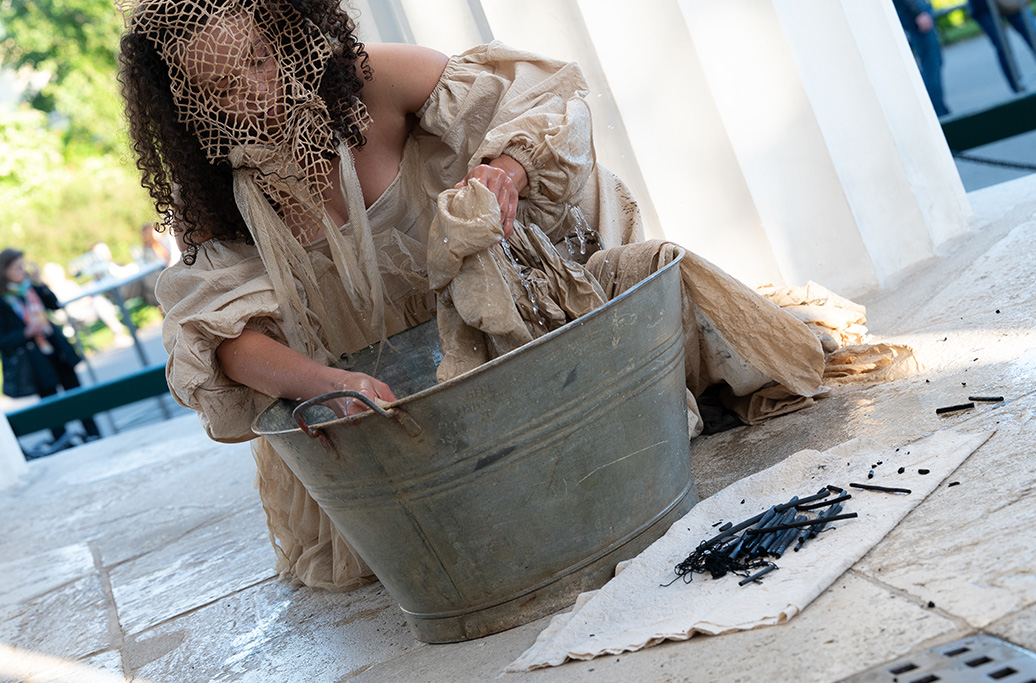
‘We’ve darned the same cloth’ – Performance at the Theseus Temple, Vienna, 2025. Commissioned by Weltmuseum Wien. Image courtesy of the artist and Weltmuseum Wien. Photo by Daniel Aue
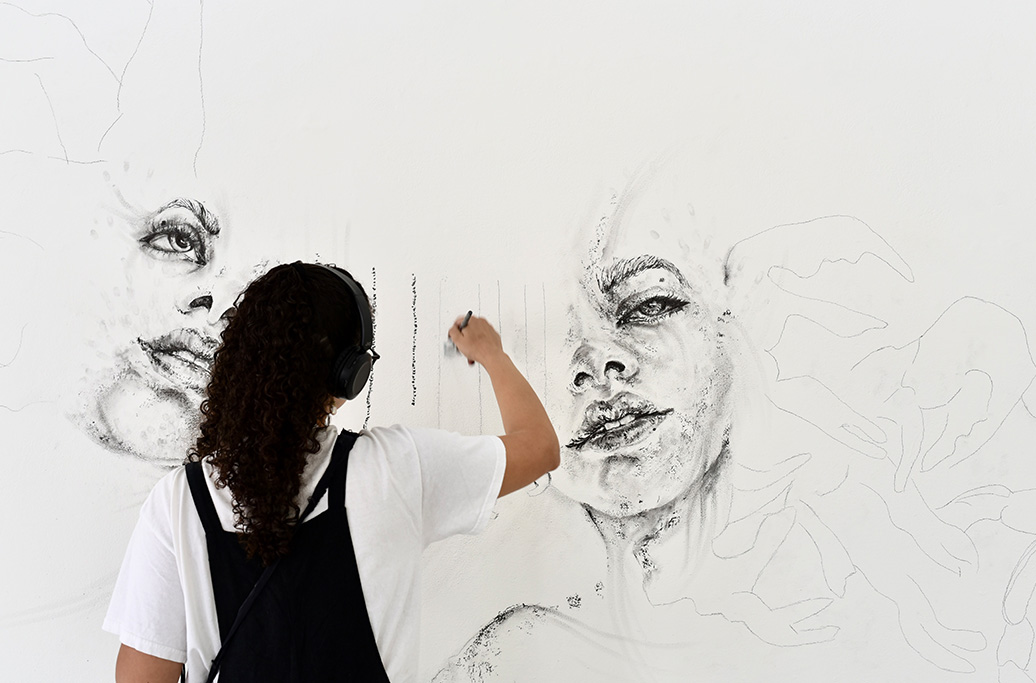
‘Together we perspire, together we retrieve’, 2025 (work-in-progress detail). Y Gallery, Port of Spain. Part of the solo exhibition Sediments. Photo by Giorvana Hadeed
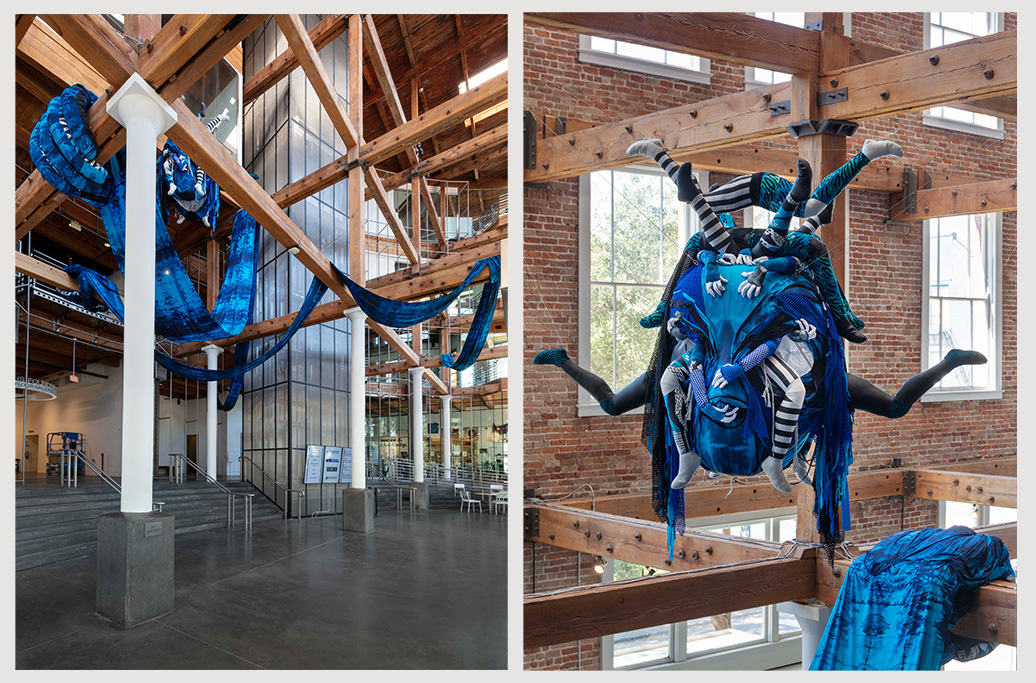
‘Three Whistles and a Howl’, 2024 (detail). Installation view at the Contemporary Arts Center, New Orleans, Prospect.6: The Future Is Present, The Harbinger Is Home. Commissioned by Prospect.6. Image courtesy of the artist and Prospect New Orleans. Photo by Jonathan Traviesa.
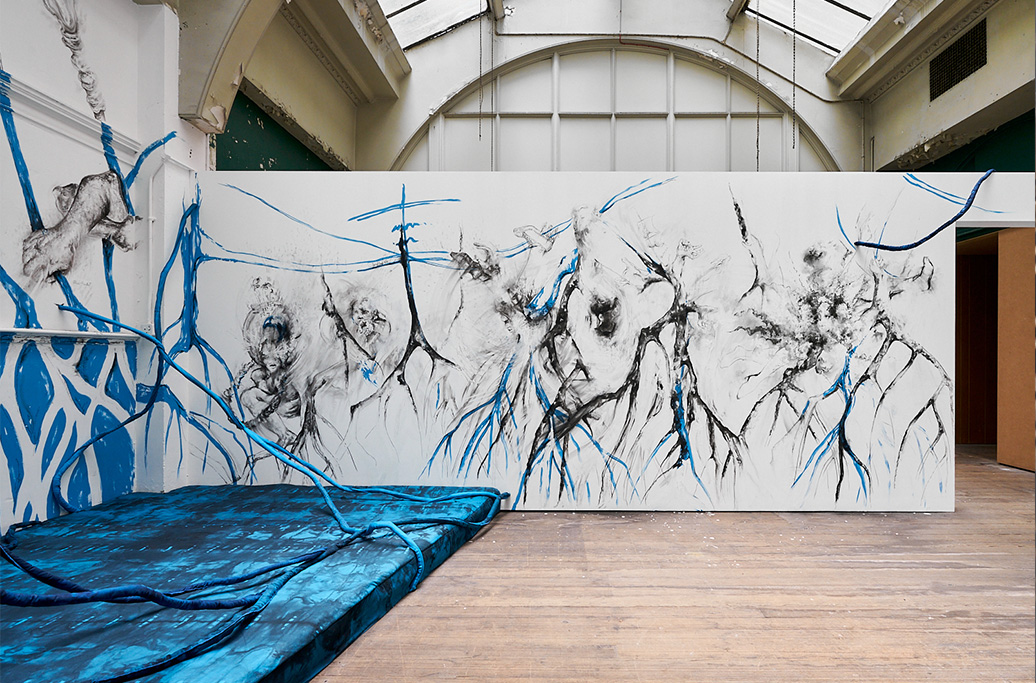
‘Mangrove’, 2023 (detail). Installation view at the Cotton Exchange, Liverpool Biennial, 2023. Commissioned by Liverpool Biennial. Image courtesy of the artist and Liverpool Biennial. Photo by Robert Battersby
Interviewer | Writer: Jovan Ravello